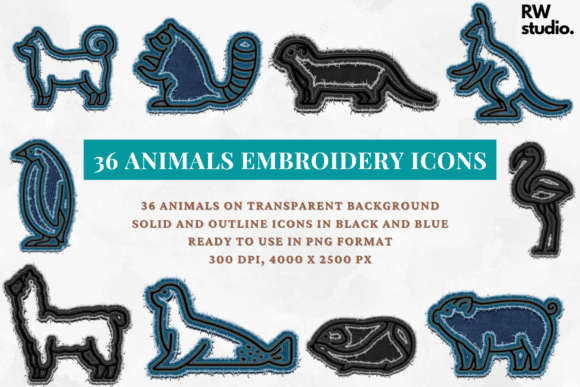
36 Animals Embroidery Icons Clipart
A Designer’s First Look: Friendly, Clean, and Ready for Real Stitching
When I opened the 36 Animals Embroidery Icons Clipart, my first thought wasn’t “cute”—it was “usable.” That’s rare. So many animal-themed embroidery files lean into heavy outlines or fussy details that fray or blur under thread. These icons feel intentionally simplified: rounded silhouettes, balanced negative space, and a consistent visual rhythm across foxes, owls, hedgehogs, sloths, and more. They don’t shout—they invite. And that makes them perfect for projects where charm matters more than complexity: baby onesies, linen tea towels, minimalist tote bags, or nursery wall art.
How It Stitches in the Real World
I tested three icons—fox, turtle, and owl—on a custom embroidered tote bag (medium-weight canvas), a soft cotton sweatshirt, and a lightweight baby blanket. On the tote, the icons held crisp edges with minimal stabilizer; the satin stitch borders stayed smooth, and fill stitches laid flat without pilling. On the sweatshirt, I used medium cutaway stabilizer and reduced density slightly—the design didn’t sink or distort, even over seams. The baby blanket required extra care: I switched to a lighter tear-away stabilizer and shortened stitch length on finer details like ears and tails. All three stitched cleanly, with no skipped stitches or thread breaks.
Where this set shines is in versatility without compromise. As an embroidery designer who ships 50+ custom orders monthly, I need icons that scale well—from 2-inch patches on denim jackets to 4-inch applique designs on pillow covers. These icons scale predictably. No jagged edges when enlarged, no vanishing details when reduced. That’s critical for Etsy sellers offering multiple size options or small shop owners building cohesive product lines (e.g., matching aprons + tea towels + greeting cards).
Smart Use Cases—and Where to Pause
The 36 Animals Embroidery Icons Clipart works beautifully for:
- Personalized gifts: A single icon on a child’s backpack or holiday stocking feels intentional, not generic.
- Small business merchandise: Think boutique-branded kitchen towels, embroidered cap fronts, or gift-ready pillow covers—clean, recognizable, and brand-friendly.
- Digital product previews: These icons translate well into printable mockups for social media or Etsy listings. Their consistency helps customers visualize how a finished product will look—even before stitching begins.
- Holiday and seasonal collections: Pair a reindeer with red thread on cream linen, or a bunny with pastel thread on organic cotton—no redesign needed.
But here’s where attention matters:
- Curved surfaces like caps or curved pillow seams require careful placement—avoid icons with long horizontal elements (e.g., a stretched-out snake) unless you’re using a cap hoop and dense stabilizer.
- Thin or stretchy fabrics (like jersey or rayon blends) need tighter hooping and light topping—some icons with fine legs or whiskers may ghost or blur without it.
- Dark fabric backgrounds demand high-contrast thread colors. Test black icons on navy twill with white or metallic thread—it’s not automatic; it’s intentional.
- Frequent-wash items (baby clothes, kitchen linens) benefit from reinforced satin stitch borders and secure jump stitches—review your machine’s settings before finalizing.
What It Adds to Your Finished Product—Beyond Aesthetics
This isn’t just about decoration. The 36 Animals Embroidery Icons Clipart elevates perceived value. A simple cotton apron becomes a handmade product with personality. A plain sweatshirt gains warmth and approachability. Customers notice that difference—it builds trust. When someone sees clean, confident stitching on a small shop product, they assume care went into every step: design selection, fabric choice, thread pairing, and finishing.
For craft business owners, these icons support brand consistency across categories. Use the same fox icon on your Etsy banner, your embroidered patch, and your printable greeting card—and customers recognize your voice. That cohesion increases buyer engagement and repeat purchases. And because the icons avoid trendy exaggeration (no glitter effects, no hyper-realistic fur textures), they age well—ideal for holiday embroidery year after year or nursery decor that transitions beyond babyhood.
Practical Notes Every Embroidery Designer Should Check
Before cutting fabric or listing a new product, I always run through this quick checklist with any new embroidery file:
- Test on scrap fabric first—especially if using textured or dark material.
- Review stitch density: High density looks lush but can stiffen lightweight fabric; low density may lack definition on thick knits.
- Confirm hoop size compatibility: Some icons may exceed standard 4x4 hoops at full size—check before digitizing or resizing.
- Inspect small details under magnification: Are eyes or paw pads legible at 1.5 inches? Will they stitch cleanly on 100-count linen?
- Try black-and-white mockups: If the icon reads clearly without color, it’ll hold up across thread palettes and fabric tones.
- Use proper stabilizer: Medium cutaway for knits, tear-away for stable wovens, and water-soluble for delicate layers.
- Verify licensing: Since this is marketed as ready-to-use for posters, stickers, and wall art, confirm whether commercial embroidery rights are included—especially if selling finished embroidered products or digital embroidery files.
Final Thought: A Quietly Powerful Design Asset
The 36 Animals Embroidery Icons Clipart doesn’t try to be everything. It’s not photorealistic. It’s not overloaded with decorative flourishes. It’s focused, functional, and quietly expressive—exactly what busy designers, Etsy sellers, and small shop owners need when time is tight and quality can’t slip. Whether you’re stitching a single personalized gift or scaling a line of boutique merchandise, these icons give you reliable visual language—no reworking, no second-guessing, just thoughtful, stitch-ready design.