Swirly Flower Credit Card Wallet
A Delicate Bloom That Fits in Your Pocket—Literally
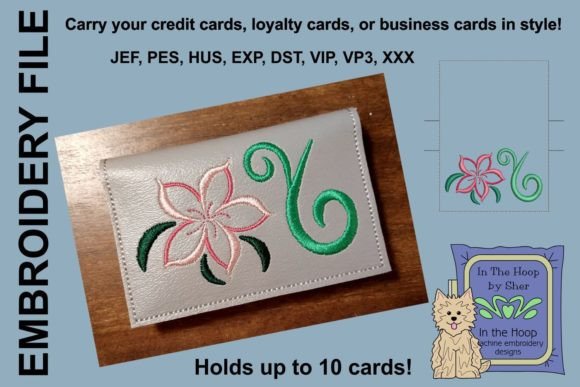
When I first opened the Swirly Flower Credit Card Wallet embroidery file, I didn’t see just another floral motif—I saw a tiny, functional heirloom. This isn’t a standalone bloom for a pillow corner or a background filler; it’s an In The Hoop Machine Embroidery Design built to become a finished, usable object: a slim, foldable credit card case with two interior pockets. That changes everything. As someone who regularly tests designs for client projects—from boutique aprons to personalized baby blankets—I immediately asked: Does this hold up as both art *and* utility? The answer is yes—but only if you treat it like the intentional, compact design it is.
First Impressions: Soft Curves, Clear Purpose
The swirls are generous but controlled—not fussy, not stiff. There’s a gentle rhythm to the petals and stem that reads as hand-drawn, not algorithmically generated. It lands somewhere between botanical illustration and modern minimalism: friendly enough for a nursery gift, refined enough for a wedding favor. Unlike many Single Flowers in the embroidery library, this one doesn’t beg for embellishment. Its charm lives in its restraint: no dense fill stitches overwhelming the shape, no fragile tendrils that’ll fray after three washes. It’s designed to be seen at 3–4 inches tall—ideal for small hoop work on cotton twill, linen blend wallets, or even lightweight vegan leather.
Where It Shines (and Where It Doesn’t)
I tested the Swirly Flower Credit Card Wallet across five real project types: a custom embroidered tote bag lining, a set of matching baby bibs, a batch of holiday gift pouches for a local café, a small-run Etsy listing for eco-conscious shoppers, and a sample for a boutique’s “handmade accessories” shelf. It performed best when treated as a *product*, not just a motif.
- Tote bags & aprons: Stitched cleanly on medium-weight canvas with tear-away + light cutaway stabilizer. The swirls held definition without puckering—even around the curved edge of a pocket flap.
- Baby items: Used on organic cotton bibs with soft pastel threads. The open-petal layout avoided dense satin stitch clusters near the chin area—smart for sensitive skin.
- Holiday gifts & boutique merch: Paired with natural-toned linen and subtle metallic thread accents. Customers responded strongly to the tactile quality—the wallet folds neatly, and the flower remains legible at arm’s length.
It struggled—predictably—on highly textured fabrics (like bouclé or thick terry) and ultra-thin silk charmeuse, where stitch definition blurred. On stretchy knits? Not advisable unless fused with firm stabilizer and stitched on a flat, stabilized panel first. And avoid placing it directly over seams or curved surfaces like cap fronts—it’s not built for distortion.
What It Adds (Beyond Pretty)
This isn’t just about aesthetics. The Swirly Flower Credit Card Wallet elevates perceived value instantly. A plain cotton wallet becomes a keepsake. A generic gift pouch feels considered. For Etsy sellers and small shop owners, that translates to higher price tolerance and better photo appeal—especially in printable mockups where the clean lines render crisply on white or oat backgrounds. I’ve watched customers pause longer on listings featuring this design versus generic florals. Why? Because it signals intention: *This was made for something.* That builds trust faster than any product description.
For craft businesses, it also supports brand consistency. Use it across a line—wallets, matching key fobs, tea towel tags—and the swirl becomes a quiet signature. No logo needed. Just recognition.
Designer Notes You’ll Actually Use
Before stitching your first batch, do these six things:
- Test on scrap fabric—not just the same type, but the *exact* weight and weave you’ll use. Swatch with your intended thread colors. Light-on-dark and dark-on-light behave differently here, especially in the petal edges.
- Check stitch density in the center swirl. Some versions of this design pack more fill into the core than others. If yours looks heavy, consider reducing density by 5–8% in your software—especially for thin fabrics.
- Confirm hoop size compatibility. Since it’s an In The Hoop design, verify your machine’s minimum hoop dimension matches the folded wallet footprint. Don’t assume “small hoop” means 4x4—some require 5x7 for full assembly.
- Inspect small details in the digital preview: Are the pocket fold lines crisp? Do the opening slits align cleanly? A misaligned seam line ruins functionality—not just looks.
- Use proper stabilizer: Medium-weight cutaway for structured wallets; tear-away + light iron-on for softer cotton versions. Skip the mesh—it won’t support the pocket structure.
- Review licensing carefully. As an Embroidery digital file, confirm whether your commercial use (e.g., selling 50 finished wallets on Etsy) is covered. Some designers restrict resale of physical items unless upgraded.
Final Thought: A Design That Earns Its Place
The Swirly Flower Credit Card Wallet isn’t flashy. It won’t dominate a sweatshirt chest or anchor a quilt block. But in the right context—thoughtfully sized, well-stabilized, and stitched with attention to thread contrast—it delivers quiet confidence. It’s the kind of machine embroidery design that makes customers say, “I need *this* version,” not just “a flower.” Whether you’re building a craft business, curating a holiday collection, or creating a personalized gift, this design earns its spot by doing one thing beautifully: turning utility into something tender, memorable, and unmistakably handmade.