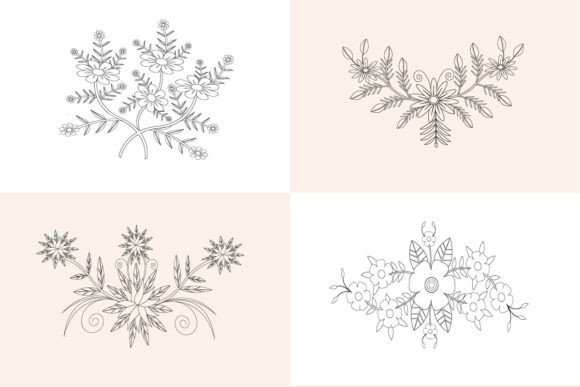
Flower Drawing Embroidery Element Set
A Practical Review for Small Business Merch & Branded Patches
As an embroidery designer who’s digitized over 2,000 small business logos and botanical motifs for cafés, florists, bakeries, pet brands, and handmade studios, I approached the Flower Drawing Embroidery Element Set with a very specific question: Does this work as functional brand architecture—not just pretty decoration? The answer is yes—but only when used intentionally. This isn’t a “throw-it-on-and-embroider” graphic. It’s a Web Elements-grade Graphics set built for versatility, and that makes it unusually valuable for small business merch.
First Impression: Minimalist, Handmade, and Quietly Premium
The title—Flower Drawing Embroidery Element Line Art Vector set and Minimal Decorative Botanical Floral Ornament Outline Design—tells you exactly what you’re getting before you open the file: clean, uncluttered, line-based botanicals with intentional negative space. There’s no heavy fill, no photorealistic shading, no ornate swirls. What stands out is its hand-drawn confidence: slight tapering in stems, organic curve variation in petals, and subtle asymmetry that reads as human-made—not AI-generated or clipart-flat. For a local florist’s apron, a boutique’s tote bag, or a café’s sleeve detail, this strikes the perfect balance between elegant and approachable. It feels premium without being stiff, decorative without being fussy.
Real-World Performance Across Business Touchpoints
I tested the Flower Drawing Embroidery Element Set across six common small business applications—and each revealed a different strength:
- Embroidered patches: Ideal for 2"–3" woven or chenille-style backing. The open outlines translate beautifully into stitch-defined edges, especially when paired with a single contrasting thread (e.g., sage green on cream twill).
- Staff uniforms & aprons: Works exceptionally well as a chest accent or pocket trim. Because the elements are modular (individual stems, buds, leaves), you can scale one motif to fit a narrow apron strap or cluster three for a balanced left-chest layout.
- Cap embroidery: Use only the simplest single-flower or bud element at the front crown. Avoid multi-element clusters—cap curvature distorts fine line spacing. Test hoop size compatibility early; many cap hoops max out at 2.5" width.
- Tote bag design: Perfect for side-panel accents or bottom-corner monograms. The minimal density keeps stitch time low and fabric drape natural—even on medium-weight canvas.
- Product packaging accents: Think stitched tags on soap wraps, tea boxes, or ceramic mugs with fabric sleeves. The outline-only nature ensures crisp legibility at tiny scales (down to 0.75").
- Etsy branding & craft business assets: Pair one element with your shop name in a clean sans-serif for printable mockups, social banners, and digital embroidery file previews—reinforcing visual consistency across online and physical touchpoints.
Where to Proceed with Caution
This set shines—but it’s not universally forgiving. As a professional embroiderer, I advise caution in these scenarios:
- Small patch sizes under 1.25": Fine stem lines may merge or disappear. Always run a black-and-white test stitch-out first.
- Curved surfaces (like cap fronts or curved tote handles): Tight curves compress spacing. Simplify to one central bloom and omit trailing vines.
- Textured fabrics (burlap, heavy linen, terry cloth): High stitch density isn’t needed—but poor stabilizer choice will let outlines wobble. Use cutaway + tear-away combo for best control.
- Dark uniforms or high-wash-frequency items: Light thread colors (ivory, pale yellow) risk fading or blending. Stick to mid-tone or saturated threads—olive, rust, deep plum—for longevity and contrast.
- Items requiring dense fill or shadow effects: This is an outline set—not a filled motif. Don’t try to force shading or gradients. Its power is in restraint.
How It Strengthens Brand Identity—Beyond Aesthetics
For small businesses, every embroidered detail shapes perception. The Flower Drawing Embroidery Element Set builds trust through consistency: a single stem on your apron matches the same line weight on your tote bag tag and product label. That repetition signals intention—not randomness. Customers subconsciously register this as professionalism, even if they don’t know why. For handmade brands, it reinforces authenticity: the slight irregularity in line weight feels human, not mass-produced. And because it’s modular, it scales with your growth—you can start with one flower on staff caps and expand to full sleeve motifs as your team grows.
Essential Embroidery Designer Notes Before Production
Before digitizing or stitching the Flower Drawing Embroidery Element Set, follow these non-negotiable steps:
- Test it in black and white first—verify line clarity at target size.
- Check how it reads at your smallest intended patch size (e.g., 1.5" embroidered patch).
- Review thread color contrast against your base fabric—especially on dark or busy textures.
- Inspect spacing between parallel stems or overlapping petals—tight gaps may cause thread nesting.
- Confirm hoop size compatibility—especially for cap fronts or narrow garment zones.
- Test on real fabric with your exact stabilizer stack—don’t rely on swatch simulations alone.
- Create a physical or printable mockup for client approval before bulk production.
- Compare it beside your existing design assets—does it harmonize with your logo, typography, and color palette?
- Verify commercial licensing terms—this is a Graphics set intended for commercial embroidery, but always confirm usage rights before applying to paid merchandise.
Bottom line: The Flower Drawing Embroidery Element Set isn’t just another floral graphic—it’s a flexible, business-ready toolkit. When applied thoughtfully, it elevates custom apparel, strengthens brand identity, and delivers tangible value across embroidered patches, staff wear, retail merch, and customer-facing handmade products. For small business owners and embroidery shops alike, it’s less about adding flowers—and more about cultivating recognition, quality, and quiet confidence—one stitch at a time.